

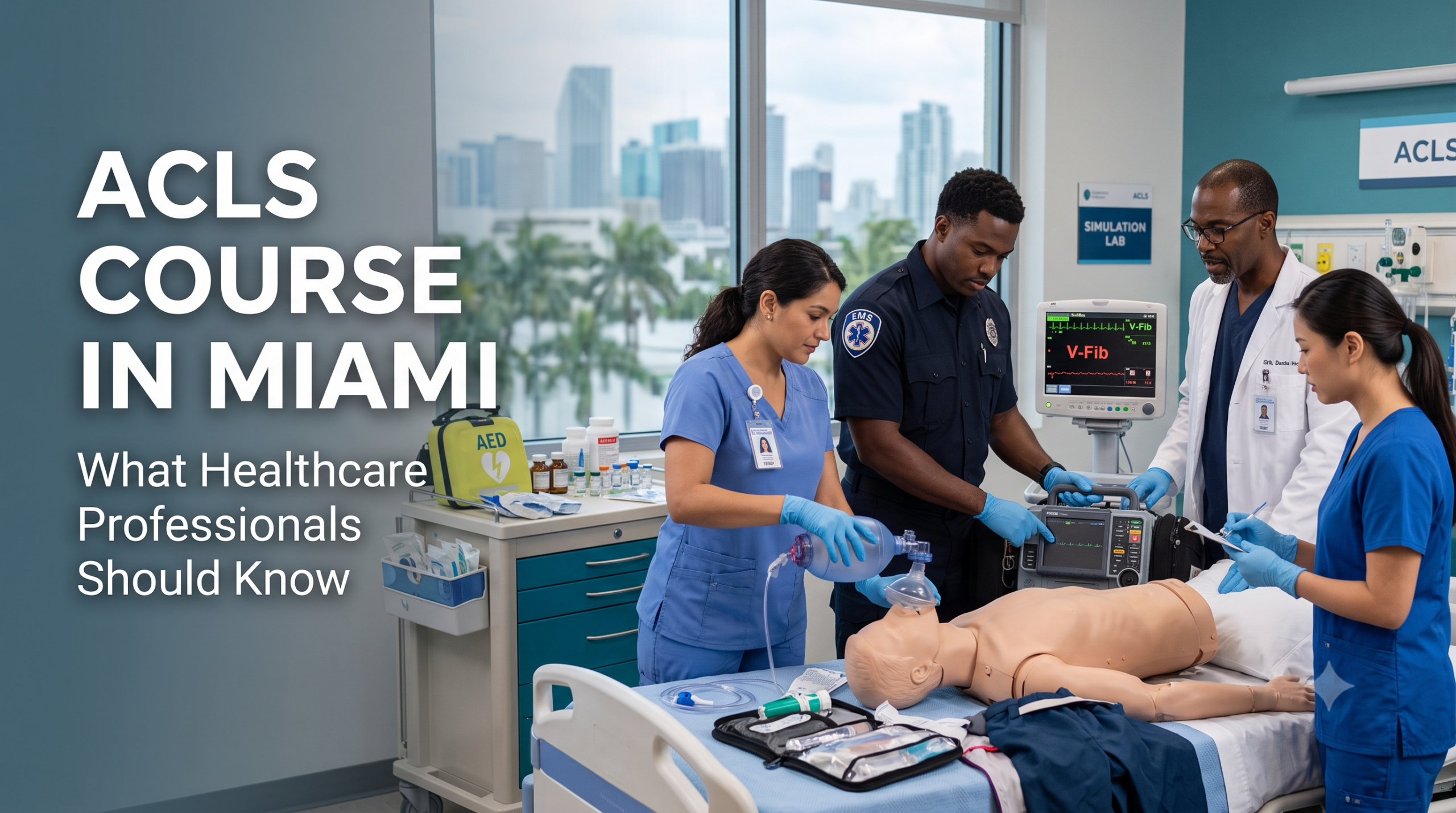
An ACLS course in Miami trains healthcare professionals to manage cardiac arrest, respiratory emergencies, and peri-arrest conditions. Initial certification typically runs 10 to 12 hours, while renewal takes 5 to 6 hours, and the course covers airway management, pharmacology, ACS/stroke response, and resuscitation team dynamics.
Table of Contents
- What an ACLS Course Actually Covers
- Initial Certification vs. Renewal: What’s the Real Difference?
- Why Location Matters More Than People Assume
- Inside the Course: What You’ll Actually Do
- How to Show Up Prepared
- ACLS vs. BLS vs. PALS: Quick Comparison
- Will This Actually Make You Better in a Code?
- Ready to Enroll?
- Frequently Asked Questions
What an ACLS Course Actually Covers
If you’re here, you probably already know the basics: ACLS, or Advanced Cardiovascular Life Support, is the certification healthcare professionals need to manage cardiac arrest and related emergencies beyond what basic CPR covers. But before you enroll in an ACLS course in Miami, it helps to know exactly what you’re signing up for.
Our ACLS course covers BLS skills, recognition of respiratory and cardiac arrest, peri-arrest conditions, airway management, pharmacology, ACS and stroke management, and team dynamics. That’s the full scope, not a partial version.
Who typically needs it? Nurses, paramedics, physicians, respiratory therapists, and anyone working in a setting where they might be first (or second) on the scene of a cardiac event. If your job puts you near a code cart, this is probably already on your radar.
Initial Certification vs. Renewal: What’s the Real Difference?
This trips people up more than you’d think. Initial certification and renewal aren’t the same course length, and they’re not meant to be.
- Initial certification: 10 to 12 hours. You’re building the full skill set from the ground up, including hands-on scenarios and team-based resuscitation practice.
- Renewal: 5 to 6 hours. You’re refreshing existing knowledge and verifying that your skills are still current, not relearning everything from scratch.
If you’ve never taken ACLS before, plan for the longer course. If you’re renewing an existing certification, you’ll move through it faster, but don’t mistake “faster” for “easier.” You’re still tested on the same standard.
Why Location Matters More Than People Assume
Here’s something people don’t think about until they’re actually scheduling: taking an ACLS course in Miami specifically (versus somewhere online with no local ties) matters for a few practical reasons. You want an in-person or hybrid skills check with an instructor who can actually correct your hand placement or your rhythm recognition in real time. You also want a provider whose scheduling accounts for South Florida’s shift patterns, hospital rotations, and, yes, hurricane-season disruptions.
Miami’s healthcare workforce runs on rotating shifts more than in a lot of markets. A provider that only offers 9-to-5 weekday sessions isn’t built for how this city actually works.
Inside the Course: What You’ll Actually Do
Let’s get concrete. Here’s roughly what an ACLS course involves, broken into stages:
| Stage | What Happens |
| BLS Skills Check | Verifying your compression, airway, and AED fundamentals are current |
| Core Content | Recognition of arrest and peri-arrest conditions, airway management, pharmacology |
| Scenario Practice | Simulated codes where you apply ACS/stroke protocols and team communication |
| Team Dynamics | Practicing roles: team leader, compressor, airway, medication administration |
| Skills Testing | Demonstrating competency in a realistic resuscitation scenario |
That team dynamics piece deserves a mention because it’s easy to underestimate. A code isn’t a solo event. Knowing your role, communicating clearly, and trusting your team matter just as much as knowing the pharmacology.
How to Show Up Prepared
A few honest tips from instructors who’ve seen what trips people up:
- Review BLS fundamentals beforehand. ACLS assumes your BLS skills are already solid; it doesn’t reteach them from zero.
- Brush up on cardiac rhythms. You don’t need to be an expert, but rhythm recognition comes up fast in scenario practice.
- Expect to be an active participant. This isn’t a lecture-and-listen course. You’ll be doing compressions, calling out interventions, and working through simulated codes.
- Ask about your specific format. Whether you’re doing a fully classroom-based course or a hybrid path, know what’s expected before day one.
ACLS vs. BLS vs. PALS: Quick Comparison
People sometimes conflate these, so here’s the short version:
| Certification | Focus | Typical Length |
| BLS | Foundational CPR, AED, airway basics | Single session |
| ACLS | Advanced cardiac arrest and peri-arrest management | 10-12 hrs initial, 5-6 hrs renewal |
| PALS | Pediatric emergency response | Similar structure, pediatric focus |
ACLS builds directly on BLS. If your BLS certification has lapsed, expect that to come up before you’re cleared for ACLS scenario testing.
Will This Actually Make You Better in a Code, or Is It Just a Card?
Fair question, and one we hear more than you’d expect. Here’s our honest answer: it depends entirely on how the course is taught. A course that rushes through scenarios just to check a box will hand you a card, sure, but it won’t build the instinct you need when a real code is unfolding around you.
That’s exactly why we lean so heavily on scenario-based practice and instructors with real field experience. Our faculty brings over 40 years of combined experience across medical, fire, and educational fields, which means the people running your scenarios have actually worked codes, not just taught about them. We’re also an AHA training site, so the course you take reflects current American Heart Association standards, not an outdated version.
Ready to Enroll?
If you’re due for initial ACLS certification or a renewal, we make scheduling straightforward. Courses run class-based, hybrid, and online, with flexible scheduling built around real shift work, not the other way around. Beyond ACLS, our broader continuing education courses also include BLS, PALS, and PHTLS if you’re building out multiple certifications at once.
If you’re early in your EMS career and considering the full pathway, our paramedic training program covers advanced procedures like IV therapy and cardioversion well beyond the ACLS scope. Call us at 305-233-3911 to schedule or ask any questions before you commit to a date.
Frequently Asked Questions
Q1. How long does ACLS certification last before I need to renew?
A. Most ACLS certifications are valid for two years before renewal is required, though this can depend on your employer’s specific policy. We recommend scheduling your renewal a few weeks before expiration so there’s no gap in active certification.
Q2. Can I take ACLS entirely online in Florida?
A. Fully online-only ACLS typically won’t satisfy employer or licensing requirements, since hands-on skills testing needs a live instructor. Our hybrid format pairs online coursework with an in-person skills session to meet that requirement.
Q3. Do I need current BLS certification before starting ACLS?
A. Yes. ACLS assumes your BLS skills, including compressions and AED use, are current, and you’ll be tested on them at the start of the course before moving on to ACLS-specific content.
Q4. What happens if I fail the skills testing portion?
A. It happens occasionally, and it’s not the end of the world. Instructors typically work with you on the specific skill that needs improvement and offer a retest, rather than requiring you to restart the entire course.
