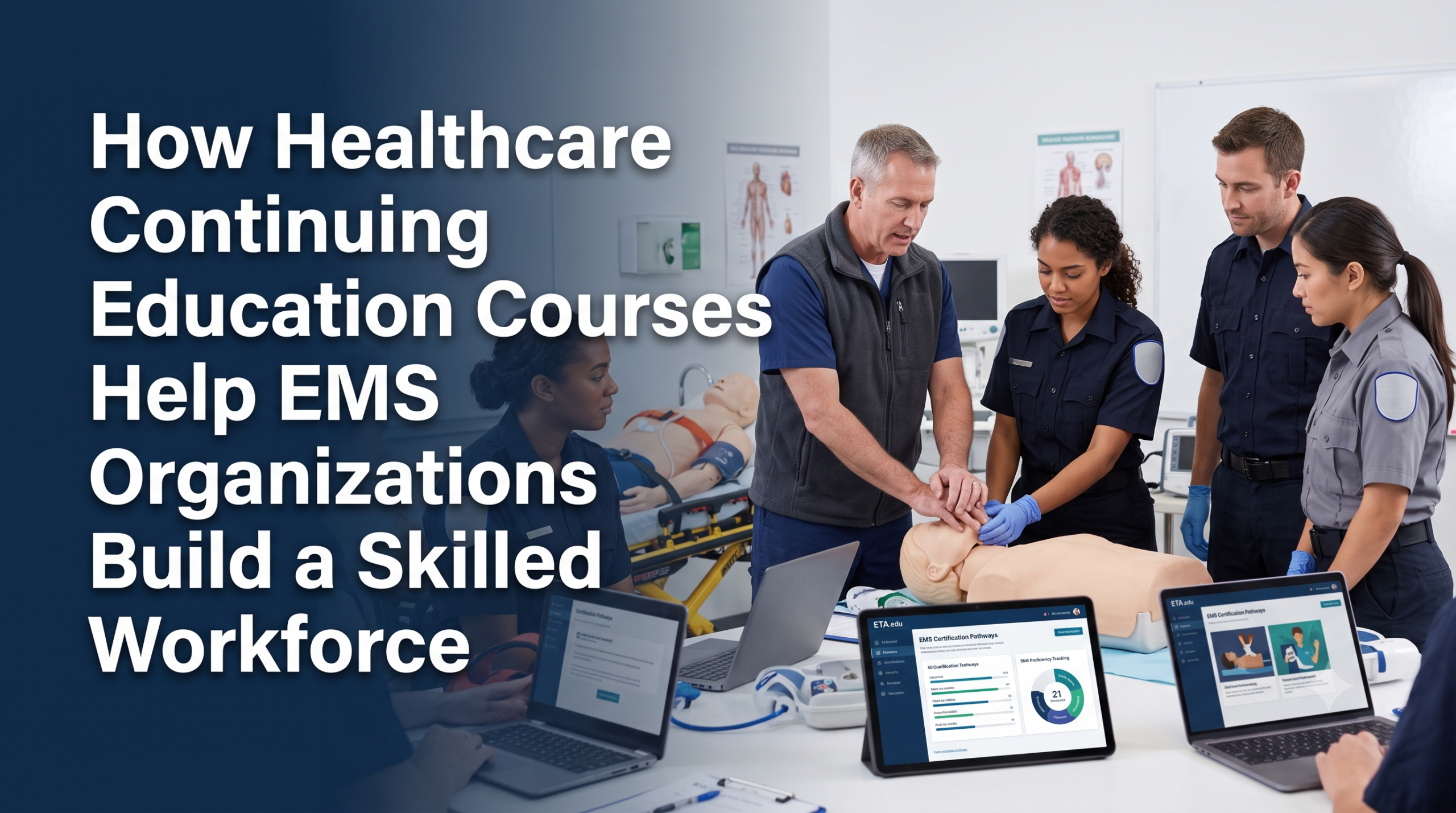
Continuing education for healthcare professionals in Miami includes courses like ACLS, BLS, PALS, and PHTLS, required to maintain licensure and keep clinical skills current. Programs are offered through accredited providers in class-based, hybrid, and online formats, with course lengths ranging from a few hours to several days depending on certification level.
Table of Contents
- What Continuing Education Actually Means for Healthcare Professionals
- Why This Isn’t Just a Box to Check
- The Course Types You’ll Run Into Most
- How to Choose a Provider That’s Actually Worth Your Time
- Checkbox Course or Real Skill-Building? Here’s the Difference
- Why Healthcare Professionals in Miami Choose ETA
- Your Next Step
- Frequently Asked Questions
What Continuing Education Actually Means for Healthcare Professionals
Continuing education, or CE, is the ongoing training that healthcare professionals complete to keep their licenses active and their skills sharp. It’s not a one-and-done thing. Medicine changes, and what you learned in school five years ago might already be outdated.
For anyone working in EMS, nursing, or allied health in Florida, our continuing education programs typically cover courses like BLS, ACLS, PALS, and PHTLS. Some are required for licensure renewal. Others just make you better at your job.
Here in Miami, that carries extra weight. Dense population, heavy tourism, and hurricane season mean local EMS and hospital staff see a wider mix of emergencies than in many other markets. Staying current isn’t optional if you want to be ready for what shows up on shift, and it’s part of why we treat CE as a genuine skills program rather than a formality.
Why This Isn’t Just a Box to Check
We’ll be honest: a lot of people view CE as an annoying requirement standing between them and their next license renewal. We get it. But there’s a real difference between renewing a license and staying competent, and the two don’t always overlap.
Three things CE genuinely does for you:
- Keeps skills from fading. Muscle memory for CPR compressions or airway management degrades faster than people expect.
- Reflects updated guidelines. Courses like ACLS get revised as the American Heart Association updates its CPR and Emergency Cardiovascular Care guidelines.
- Opens career doors. Extra certifications often qualify you for roles that require them, meaning more flexibility and pay.
The Course Types You’ll Run Into Most
Here’s a quick rundown of the courses that come up most often for healthcare professionals in our area.
| Course | What It Covers | Who Typically Needs It |
| BLS (Basic Life Support) | CPR, AED use, airway basics | Nearly all clinical staff |
| ACLS (Advanced Cardiovascular Life Support) | Cardiac arrest management, pharmacology, team dynamics | Nurses, paramedics, physicians |
| PALS (Pediatric Advanced Life Support) | Pediatric emergency response | Pediatric and ER staff |
| PHTLS (Prehospital Trauma Life Support) | Trauma assessment and management | EMTs, paramedics, trauma teams |
Our ACLS course runs 10 to 12 hours for initial certification and 5 to 6 hours for renewal, covering BLS skills, recognition of respiratory and cardiac arrest, airway management, pharmacology, ACS and stroke management, and team dynamics.
How to Choose a Provider That’s Actually Worth Your Time
This is where a lot of people get stuck, and honestly, it’s worth slowing down for. Choosing a CE provider isn’t like picking a coffee shop; a bad choice can leave you technically certified but genuinely underprepared. Not all CE providers are created equal. Here’s what we’d tell a friend to look for:
- Real accreditation. AHA training site status, NAEMT affiliation, or NREMT and FAEMSE recognition signals that the provider actually follows recognized standards.
- Hands-on components. Skills like airway management and CPR need physical practice, not just a video and a quiz.
- Shift-friendly scheduling. If a provider only runs courses during standard business hours, that’s a red flag for shift workers.
- Instructors who’ve worked in the field. That experience teaches differently than someone reading off a slide deck.
Format matters too. Some CE courses work fine fully online. BLS and ACLS, especially, still require an in-person or hybrid skills check.
Checkbox Course or Real Skill-Building? Here’s the Difference
Here’s an uncomfortable truth: some CE courses exist purely to satisfy a licensing requirement with minimal effort. You watch a video, click through slides, and get your certificate. Technically compliant. Practically useless if you actually need those skills in a code situation.
A course built for real skill retention looks different. It includes scenario-based practice and instructors who correct your technique in real time, not just your quiz score. The difference shows up exactly when you don’t want it to: during an actual emergency.
If you’ve ever left a CE course feeling like you didn’t learn anything new, that’s usually a sign it prioritized speed over substance.
Why Healthcare Professionals in Miami Choose ETA
We built our programs around the gap we just described. Our faculty carries over 40 years of combined experience across medical, fire, and educational fields, and that shapes how we teach, not just what we teach. It’s the difference between an instructor reading a slide and one who’s actually run code, and students notice that difference fast.
A few specifics worth knowing:
- AHA training site and NAEMT training center.
- Affiliated with NREMT, FAEMSE, ECSI, AAOS’s Control the Bleed program, and EVOC.
- Licensed through the Commission for Independent Education, Florida DOE (License #4770) and the Florida Bureau of EMS (License #154).
- Class-based, hybrid, and online formats, built for people working real shifts.
If you’ve completed our EMT programs in Florida or you’re working toward our paramedic training program, our CE courses build on that foundation instead of repeating it. And if ACLS is what you’re after, our ACLS course in Miami covers both initial certification and renewal.
Your Next Step
If your certification is expiring soon, or you want Miami training that actually holds up under pressure, call us at 305-233-3911. We’ll help you figure out which courses fit your role, schedule, and timeline. No pressure, just a straight answer.
Frequently Asked Questions
Q.1 How many CE hours do Florida EMTs need to maintain licensure?
A. Requirements vary by role and renewal cycle, and Florida sets these rules at the state level. Confirm your specific hour requirement through the Florida Bureau of EMS, and then we can help map courses to meet it.
Q.2 Is ACLS renewal actually shorter than initial certification?
A. Yes. Renewal takes 5 to 6 hours, compared to 10 to 12 hours for initial certification, since you’re refreshing existing knowledge rather than building it from scratch.
Q.3 Can I complete continuing education courses without leaving my current job?
A. Most of our students do exactly that. Hybrid formats and evening or weekend scheduling make it possible to complete CE requirements without taking extended time off.
Q.4 Do all continuing education courses require an in-person skills test?
A. Not all, but several do, including BLS and ACLS, since hands-on skills like compressions can’t be fully verified online. We’ll tell you upfront which format applies.