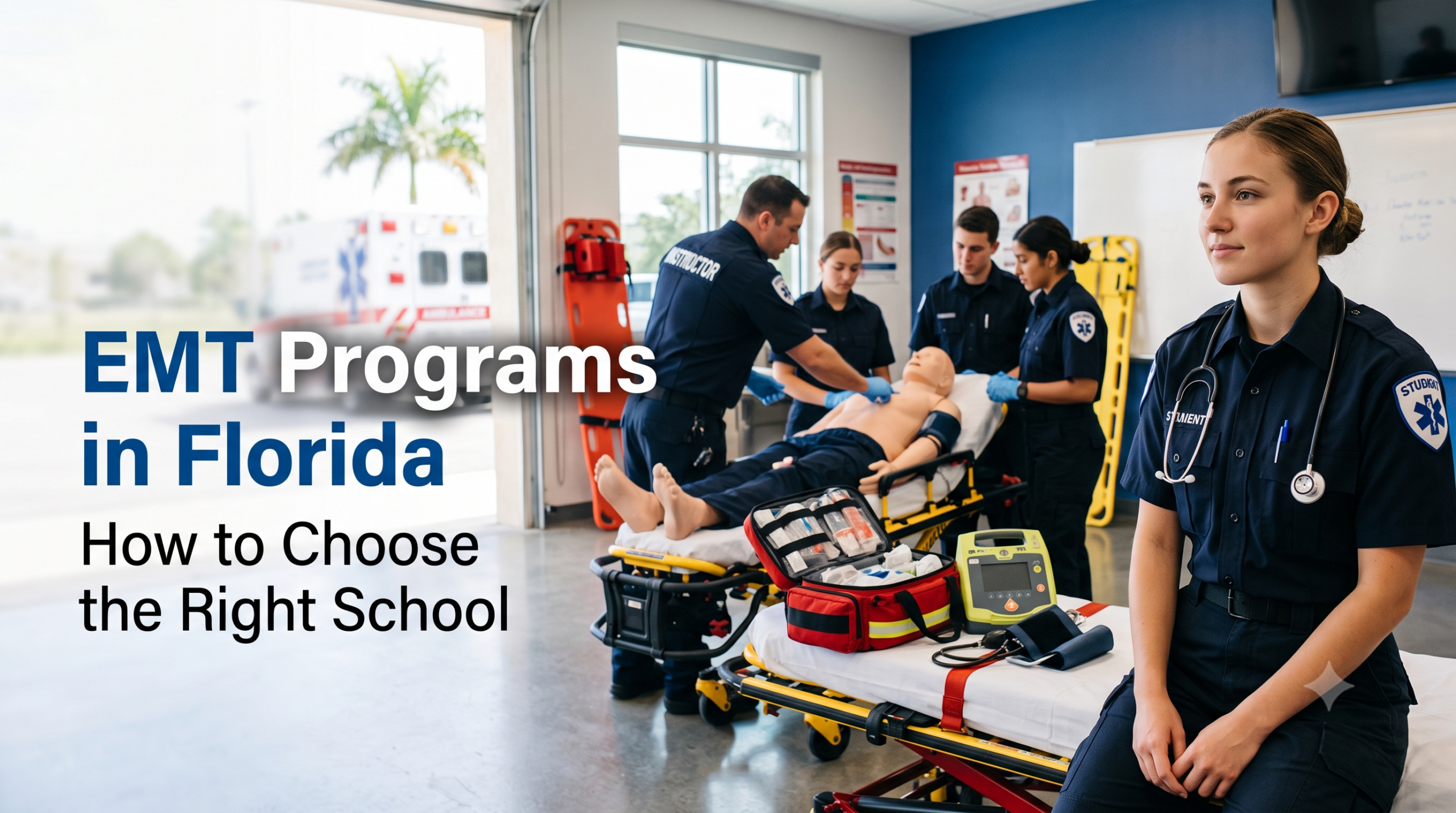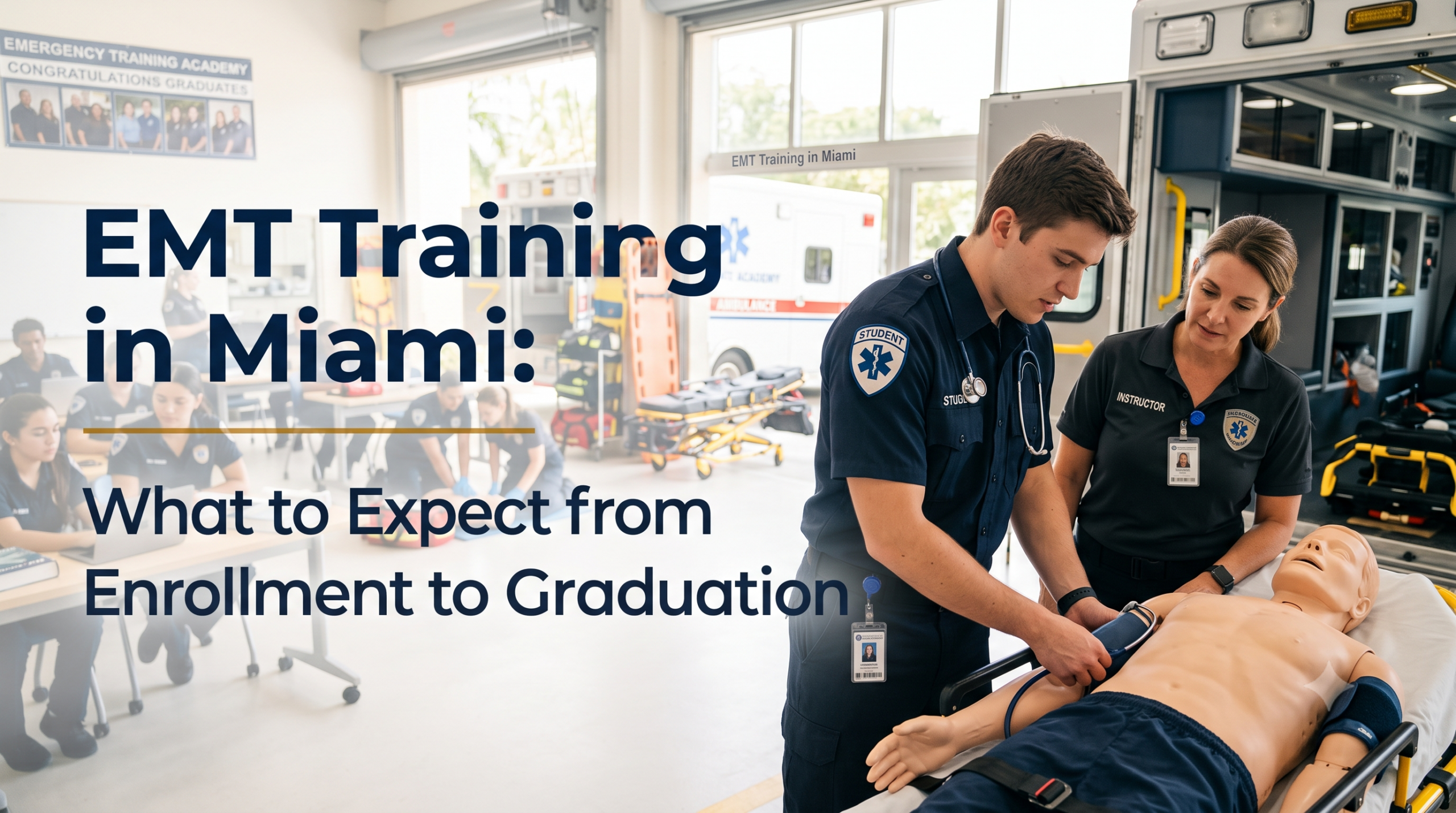
EMT training in Miami at Emergency Training Academy includes 300 clock hours of classroom instruction, lab training, hospital clinical externships, and field externships. Before enrollment, students must meet ETA’s admission requirements, including a high school diploma or GED, a physical exam, required health records, a background check, a drug screening, identification documents, and BLS for Healthcare Provider certification.
Starting a new training program comes with plenty of questions. What do you need before you apply? What happens once classes start? How much time do you spend in a classroom?
Those are all fair questions. If you are looking into EMT training in Miami, it helps to know what the program looks like from the first application to the final requirements. The EMT program at Emergency Training Academy includes classroom instruction, hands-on lab training, hospital clinical externships, and field externships.
Here is what you can expect along the way.
What Happens Before You Enroll?
The enrollment process starts with the application. You need to complete the application and the required forms, agreements, and waivers. You also sign an enrollment agreement and acknowledge the school’s policies and procedures.
There are a few other things to take care of before your training begins. You must be at least 18 years old when you graduate. If you are planning to start the program before turning 18, it’s important to get your parent’s or guardian’s consent. Moreover, you must have a high school diploma or GED.
You also need a physical examination from a licensed physician. ETA requires the examination to be completed within six months of submitting your application.
Then there are the health records. Since the program includes clinical and field externships, ETA requires vaccination records or proof of immunity for certain conditions.
Along with these documents, make sure you have documentation of U.S. citizenship, U.S. residency, or a student visa waiver before you start your application. Keep your Social Security Card and a current state ID or driver’s license close, too. It keeps the process simple and gives you one less thing to worry about once classes get closer.
What Else Is Part Of The EMT Enrollment Process?
The application is not the only part of enrollment. ETA also requires a minimum 10-panel drug screening and a background check. The initial drug screening and background check are included in the course cost.
BLS for Healthcare Provider certification is another requirement for EMT students. ETA states that the certification is included in the course cost when the student attends the scheduled course.
If you are considering an EMT training program, these requirements are worth checking early. The last thing you want is to wait until the last day and then realize you still need an important document or health record.
Class size is another thing to keep in mind. Students are admitted based on the submission date of their completed application until the class reaches maximum occupancy. After that, additional applicants go on a waiting list.
What Does the Classroom Portion Cover?
Once you are in the program, the classroom is where you build your basic EMT knowledge. ETA’s EMT lecture portion includes 152 clock hours and follows the curriculum set forth by the United States Department of Transportation.
The subjects cover a wide range of situations you may come across in emergency medical care. You learn about:
- bloodborne pathogens
- scene size-up
- patient assessment
- airway care
- respiratory problems
- cardiology emergencies
- medical emergencies
- pediatric emergencies
- trauma emergencies
- ambulance operations
In addition, the program covers anatomy and physiology, emergency medical services systems, special considerations in the pre-hospital setting, and patient transportation.
What Happens During Hands-On Training?
The lab is where classroom knowledge starts to become physical skill. ETA’s EMT laboratory includes 52 clock hours and covers skills such as patient assessment, airway adjuncts, bandaging, spinal immobilization, stair chair use, scoop stretcher use, lifting patients, obtaining vital signs, glucometer operations, EKG setup, KED use, traction splints, and assisting a patient with medication.
Medical scenarios and psychomotor evaluation are also part of the lab.
This is an important part of EMT training because reading about a skill and actually practicing it are two different things. The lab gives you time to work with the skills you learn in class before you move into the clinical and field portions of the program.
What Are The Hospital Externships Like?
The hospital clinical externship offers a different perspective on patient care. ETA includes 24 clock hours of supervised hospital clinical externship rotations with an instructor in an emergency department.
You may participate in patient assessments, such as taking vital signs and helping with bandaging, and assist doctors and nurses in overall patient care.
This part can make the lessons from class feel more real. You have learned the terms and practiced the skills in the lab. Now you see how that work fits into a hospital setting.
What Happens During Field Externships?
The field externship takes your training outside the classroom and hospital. ETA includes 72 clock hours of supervised field externship training at local fire-rescue departments and ambulance service providers.
Work can include patient care, taking vital signs, immobilization, documentation, and working in an uncontrolled environment. You’ll also see the teamwork involved in emergency medical care.
If you are comparing emergency medical technician programs near Miami, pay attention to the amount of field training included. Although classroom lessons matter, seeing how EMT work happens in the field gives you a different perspective.
How Do You Complete The Program And Graduate?
The EMT program at Emergency Training Academy includes 300 clock hours and 13 semester credits. In addition to meeting the program’s academic and practical requirements, students must successfully complete each phase of the course, including the didactic portion, hands-on training, hospital rotations, and field externship.
Before the final examinations, ETA requires a minimum cumulative average of 73%. The written final examination also requires a score of at least 73%.
The EMT Basic practical portion must also be completed in accordance with National Registry guidelines. This includes completing the required clinical and field externship rotations and turning in the necessary documentation.
There are a few other requirements to meet before graduation. They must also demonstrate competency in the national curriculum objectives and complete the final practical and examination requirements while maintaining a professional attitude and good behavior throughout the course.
So, finishing the last class does not mean you are automatically finished with every requirement. You need to complete the different parts of the program and meet the standards set for each one.
What Should You Consider Before Choosing an EMT Program in Miami?
When you compare EMT programs, it is easy to look at the name and location and move on. But the details of the training matter just as much.
Take a look at the number of classroom and lab hours. See if the program includes hospital and field externships, and check what you need to complete before graduation. Review the classroom, lab, hospital, and field training hours before enrolling. If you’re exploring healthcare careers, consider an ACLS course in Miami or compare Paramedic programs to understand your options.
If you are comparing EMT training programs in Miami, here are the details worth checking. Emergency Training Academy is licensed by the Commission for Independent Education of the Florida Department of Education and the Florida Bureau of EMS, so you can also take that into account as you decide whether the program is right for you.
Ready to Take the Next Step?
Choosing an EMT program is not something you have to rush. Take a look at what Emergency Training Academy in Miami offers, including the admission requirements, and see if the program fits what you are looking for. If it does, the next step is simply to start the enrollment process.
FAQs
How many hours is ETA’s EMT program?
ETA’s EMT program includes 300 total clock hours. These hours cover lecture, laboratory training, and externships.
What health documents are required for enrollment?
Students need a physical examination completed by a licensed physician within six months of submitting the application. They may also need to submit required vaccination records or proof of immunity.
Is BLS certification required for EMT students?
Yes, BLS for Healthcare Provider certification is required for EMT students. ETA states that the certification is included in the course cost when the student attends the scheduled course.
Does the program include hospital and field training?
Yes. ETA’s program includes supervised hospital clinical externships and field externships at local fire-rescue departments and ambulance service providers.