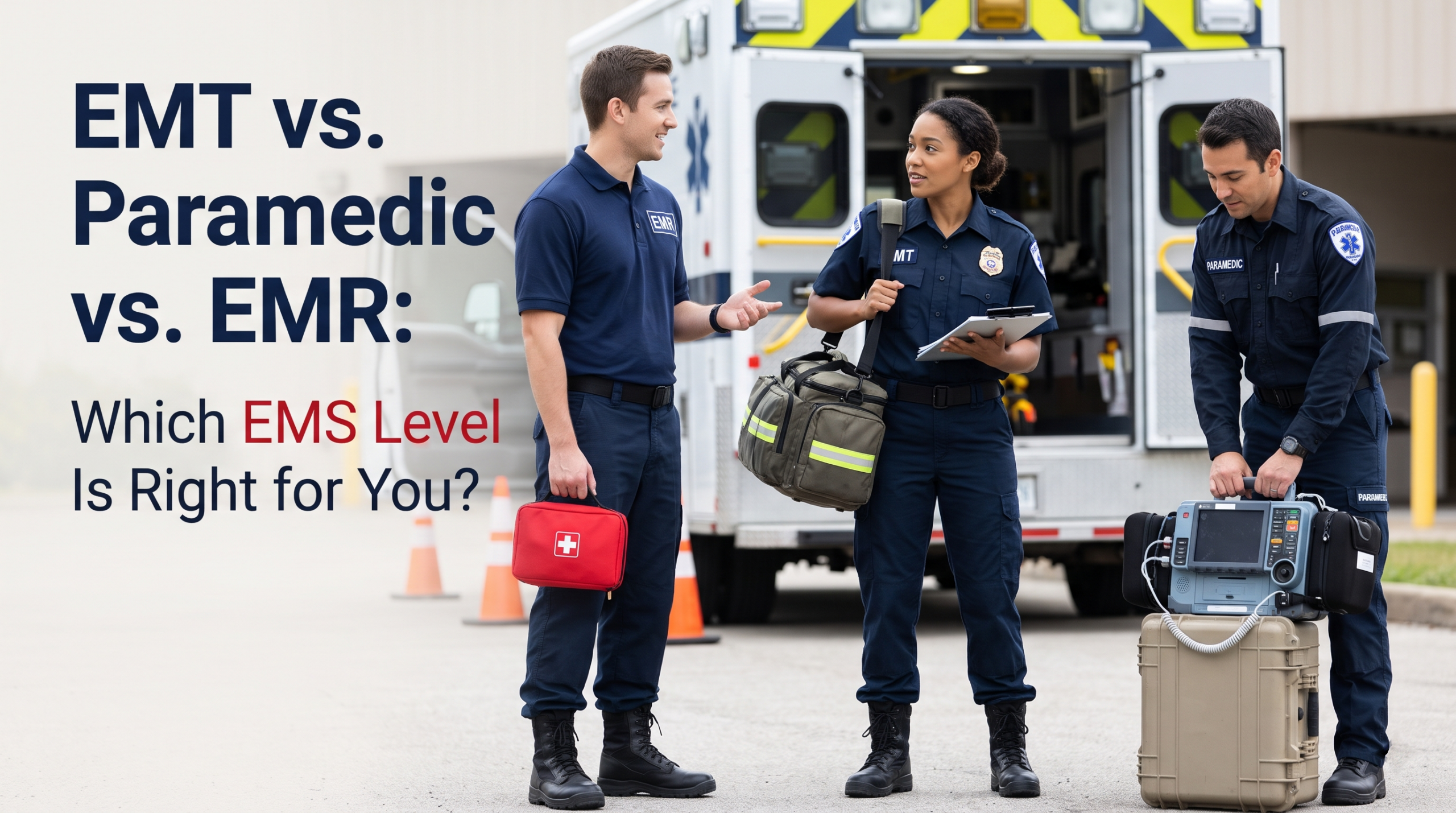
EMRs provide an initial response, EMTs assess patients and deliver basic emergency care, and paramedics receive advanced training to handle more complex medical emergencies. The right path depends on your career goals, preferred level of responsibility, and the training you want to pursue.
What Is the Difference Between an EMT, Paramedic, and EMR?
When you’re thinking about a career in emergency medical services (EMS), choosing the right training level is an important first step.
First, understand that emergency care is a team effort. Each person has a role. And every role matters when someone needs help. The main difference between an emergency medical responder, an emergency medical technician, and a paramedic is their training level and the care they’re prepared to provide.
Paramedic programs offer a path to advanced pre-hospital care, while EMT and EMR training prepare you for different roles in emergency response. At Emergency Training Academy (ETA) in Miami, we offer training options for people who want to enter EMS or build their emergency care skills.
Common EMS Levels and What They Do
Emergency Medical Responder (EMR)
An emergency medical responder is a trained professional who provides an initial response in a medical emergency. They help address urgent needs before more advanced medical providers take over.
EMR training may suit you if you:
– Want to develop basic emergency response skills.
– Prefer to begin with an introductory level of EMS education.
Our EMR training program in Miami gives you the technical skills to respond effectively to medical emergencies in a pre-hospital setting.
Emergency Medical Technician (EMT)
An EMT assesses patients and provides basic emergency care under medical oversight. Also, they help transport patients and communicate important information to other healthcare professionals. Our EMT training program is a 300-hour course that includes classroom lessons, practical lab work, field externships, and more.
Our EMT training program is a 300-hour course that includes classroom lessons, practical lab work, field externships, and more.
Paramedic
Paramedics receive more advanced training to assess and manage serious medical emergencies. Their role can include advanced airway care, medication administration, intravenous therapy, and other procedures.
Our paramedic program includes 1,100 clock hours of instruction, laboratory training, hospital clinical rotations, and field experience. The program prepares you to assess patients and provide advanced care.
EMT vs. Paramedic vs. EMR
| Factor | EMR | EMT | Paramedic |
| Main role | Initial emergency response | Patient assessment and basic emergency care | Advanced emergency assessment and care |
| Training focus | Initial response skills | Basic life support and patient care | Advanced clinical skills and procedures |
| Practical preparation | Emergency response skills | Lab work, hospital, and field externships | Labs, hospital rotations, and field internships |
| Best suited for | Those starting with introductory response skills | Those pursuing an entry-level EMS role | Those aiming for advanced pre-hospital care |
In Florida, EMTs and paramedics are the two certification levels for pre-hospital providers.
How to Choose the Right EMS Training Path
Rather than focusing on the title you will earn, think about the work you want to do:
– Choose EMR training if you want to begin with initial emergency response skills. EMR programs give you the knowledge and practical skills to respond to medical emergencies.
– If you want to prepare for a role that involves assessing patients, providing basic emergency care, and helping with patient transportation, consider EMT training.
– Go for paramedic training when you’re ready for more advanced clinical education.
You may also come across the term EMT-A training program. EMT-A generally refers to Advanced EMT training. It differs from a standard EMT course and paramedic education.
If you’re comparing an EMT-A training program with paramedic programs, we suggest checking the entry requirements and course content. Also, review the certification pathway before deciding.
What to Consider Before Choosing a Program
Here are a few questions that can help you narrow down your options:
– Your current qualifications – You will have to check whether the course requires an existing EMS license or other education before enrollment.
– Time commitment – It’s a good idea to compare the total training hours and how much time you will need for clinical and field experience.
– Hands-on learning – Since emergency care involves practical skills, look for details about lab sessions and supervised rotations.
– Long-term goals: Consider whether you want to start at the entry level or work toward advanced patient care.
– Certification requirements: Review the relevant Florida requirements and the examinations you need to complete.
At ETA, students who want to enroll in the paramedic program should have an EMT license to become eligible for paramedic training.
How Our Emergency Training Academy Can Help
Choosing a course is easier when you know what the training involves. At ETA, we provide EMS education in Miami for people interested in EMR, EMT, and paramedic training.
Our paramedic program follows the National EMS Education Standards and the Florida Bureau of Emergency Medical Services standards. Its 1,100 clock hours include lectures, laboratory sessions, hospital clinical rotations, and supervised field experience. Students work toward the knowledge, practical skills, and professional behavior expected of an entry-level paramedic.
Our EMT program offers a different starting point, with 300 clock hours covering classroom instruction, laboratory work, and clinical and field externships.
We also offer an EMR program for students interested in initial emergency response skills. You can review our available courses and ask our team about the requirements for the training path you’re considering.
It’s Time To Begin Your EMS Career
Whether you’re considering EMR training, an EMT course, or advanced paramedic education, we’re here to help you review your options.
Contact Emergency Training Academy today to request more information about our paramedic program and take the next step toward your future in emergency medical services.
FAQs
How long does it take to become an EMT in Miami?
At Emergency Training Academy, our EMT course includes 300 clock hours. You will not only cover classroom instruction, lab work, and hospital clinical rotations, but also field externships. That said, your overall timeline depends on completing the course requirements and meeting the applicable certification requirements.
What EMT programs are available in Florida?
Florida has approved EMT and paramedic training programs. In Miami, ETA offers EMT, paramedic, and EMR programs.
Who is more qualified, an EMT or a paramedic?
A paramedic generally receives more extensive clinical training. As a result, they can perform advanced medical procedures. On the other hand, EMTs provide essential emergency assessment and basic care.
How do you become a paramedic in Miami?
First, complete EMT training, obtain the required EMT license, meet the paramedic program’s admission requirements, complete paramedic education, and satisfy Florida’s certification and examination requirements. At ETA, an EMT license is a must for eligibility.