

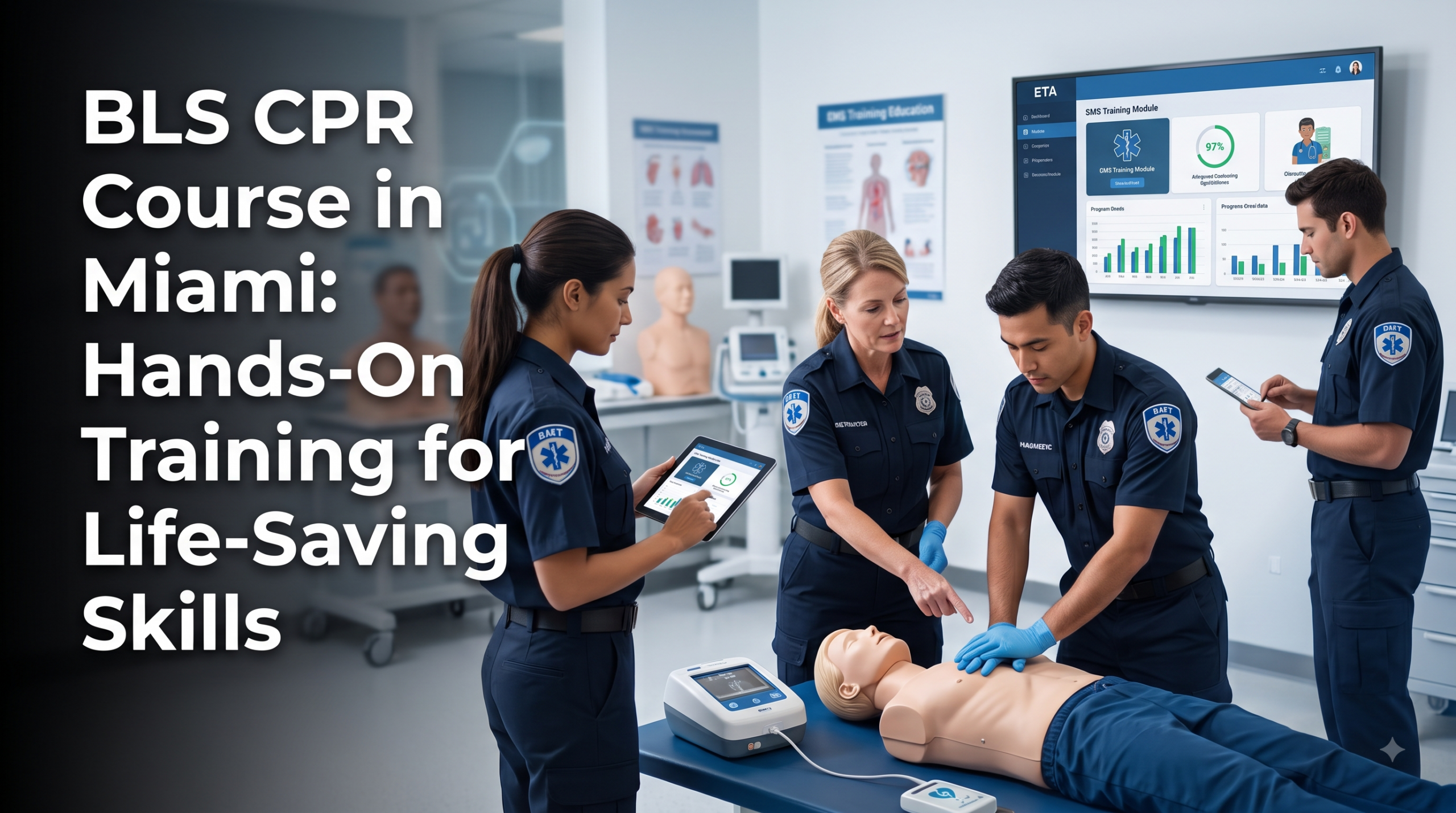
Picture this: someone collapses in front of you, no pulse, no breathing, and the ambulance is still six minutes out. What you do in the next sixty seconds matters more than almost anything else in that moment. That’s exactly why a BLS CPR course in Miami exists, and it’s why we built ours to be as hands-on as possible, instead of a box-checking exercise you forget by the time you get home. At Emergency Training Academy, BLS/CPR/AED training is part of our broader lineup of continuing education courses, and if you’re a healthcare worker (or planning to become one), this is one of the most practical certifications you can hold.
What Does BLS Actually Cover?
Basic Life Support, or BLS, is the foundation underneath nearly every other emergency medical skill. It’s not flashy. There’s no medication administration, no advanced airway placement, none of the procedures you’d see a paramedic perform. What BLS gives you is the ability to recognize an emergency fast, start chest compressions correctly, use an AED properly, and keep a person’s blood and oxygen moving until more advanced help takes over.
That sounds simple on paper. In practice, doing it correctly under stress, with adrenaline running and bystanders watching, takes real repetition. That’s the gap our course is built to close.
Who Actually Needs This Certification?
More people than you’d think. BLS isn’t just for EMTs and paramedics. Here’s a quick rundown of who typically walks through our doors for this course:
- Nurses and nursing students
- Physicians, dental staff, and other clinical professionals
- EMTs and paramedics maintaining active certification
- Fitness trainers, lifeguards, and school staff
- Anyone whose employer requires current BLS as a condition of employment
If your job puts you anywhere near patient care, or honestly anywhere near the public, this is a certification worth having current.
Inside the ETA BLS Course
As an AHA Training Site, We use the most up to date information and instruction techniques to instruct our classes. We keep our approach grounded in what actually works for skill retention: cognitive learning (understanding the “why”), affective learning (how to stay composed and make decisions under pressure), and psychomotor learning (the physical muscle memory of compressions, airway positioning, and AED use). It’s the same framework we use across all of our training, including our full EMT & paramedic curriculum, because it’s simply what produces providers who perform well when it counts.
Here’s a quick look at what’s covered:
| Area | What You’ll Learn |
| Recognition | Spotting cardiac and respiratory arrest quickly and accurately |
| Compressions | Proper depth, rate, and hand placement for effective CPR |
| Airway Management | Basic techniques to keep an airway open and clear |
| AED Use | Applying and operating an automated external defibrillator safely |
| Team Response | Coordinating with others during a resuscitation attempt |
Courses run class-based or hybrid with flexible scheduling, so you’re not stuck choosing between your job and your certification.
BLS vs. CPR/AED: Is There a Difference?
People ask this constantly, so let’s clear it up. CPR/AED training on its own typically covers compressions and defibrillator use for the general public or workplace requirements. BLS, on the other hand, is built specifically for healthcare providers and includes additional skills like two-rescuer team dynamics, closed loop communication, high-quality compression feedback, BLS Airway adjuncts, and scenario-based practice that mirrors what you’d actually face in a clinical or field setting. If your job requires “BLS for Healthcare Providers,” a general CPR class typically won’t satisfy that requirement; you’ll need the healthcare-specific version, which is what we teach.
Where BLS Fits Into a Bigger Career Picture
Here’s something worth thinking about even if BLS is all you need right now: it’s also the entry point for a lot of advanced training. Once you’ve got BLS down, courses like ACLS (Advanced Cardiovascular Life Support) build directly on top of it. Our ACLS course runs 12 to 16 hours for initial certification and 6 to 8 hours for renewal, covering everything from peri-arrest conditions and airway management to pharmacology and stroke management.
And if you’re someone who’s completed BLS and found yourself thinking, “I want to do more of this,” it’s worth knowing where that path can lead. Our EMT training program is 300 hours and our paramedic training program is 1,100 hours, follows US DOT curriculum and National EMS Education Standards, and prepares graduates for advanced procedures like IV therapy, endotracheal intubation, and cardioversion. BLS won’t get you there on its own, but it’s genuinely the first rung on that ladder.
Why Train With Emergency Training Academy?
We’re not a franchise that treats BLS certification as an afterthought between bigger programs. Our faculty carries over 60 years of combined experience across medical, fire, and educational fields, and we hold both a Commission for Independent Education Florida DOE license (License #4770) and a Florida Bureau of EMS license (License #154). We’re also an AHA training site and an NAEMT training center, with affiliations including NREMT, FAEMSE, ECSI, AAOS’s Control the Bleed program, and EVOC.
Practically, that means when you leave our course, you’re certified through a program that’s held to real accountability standards, not just handed a card and sent on your way.
A Few Things Students Don’t Expect
A couple of things tend to surprise first-time BLS students.
One: how physically tiring proper compressions actually are (a lot of people underestimate this until they’re thirty seconds into a practice scenario).
Two: how much decision-making is actually involved even in “basic” life support.
Recognizing when to start compressions, when to switch rescuers, when to stop – none of that is automatic the first time you practice it. That’s exactly why hands-on repetition matters more than watching a video and calling it done.
Ready to Get Certified?
If your certification has lapsed, or you’ve never taken a BLS course and need one for work, school, or your own peace of mind, we make it straightforward to get scheduled. Reach us at 305-233-3911, and we’ll help you find a class-based or hybrid format that actually fits your week. Our full continuing education courses lineup includes BLS alongside ACLS, PALS, and PHTLS, so if you’re building toward multiple certifications, we can help you plan that out too.
Frequently Asked Questions
How long does a BLS CPR course typically take?
Most students complete our BLS course in a single session, though exact timing depends on whether you’re doing initial certification or renewal, and whether you choose a hybrid or fully in-person format. We’ll walk you through the specific timeline when you enroll.
Does BLS certification expire?
Yes, BLS certification isn’t permanent and needs to be renewed periodically every 2 years to stay current with updated guidelines and skills. We recommend scheduling your renewal before your card actually expires so there’s no gap in your certification status.
Can I take BLS if I’m not currently working in healthcare?
Absolutely. While many of our students are healthcare professionals, we also train fitness instructors, school staff, and members of the general public who simply want the skills and confidence to respond in an emergency.
Is online BLS training legitimate for job requirements?
Our hybrid format pairs online coursework with an in-person skills session, which satisfies healthcare employer requirements that mandate hands-on skills verification, not just knowledge testing. Fully online-only options without a live skills check typically won’t meet those same requirements.
