

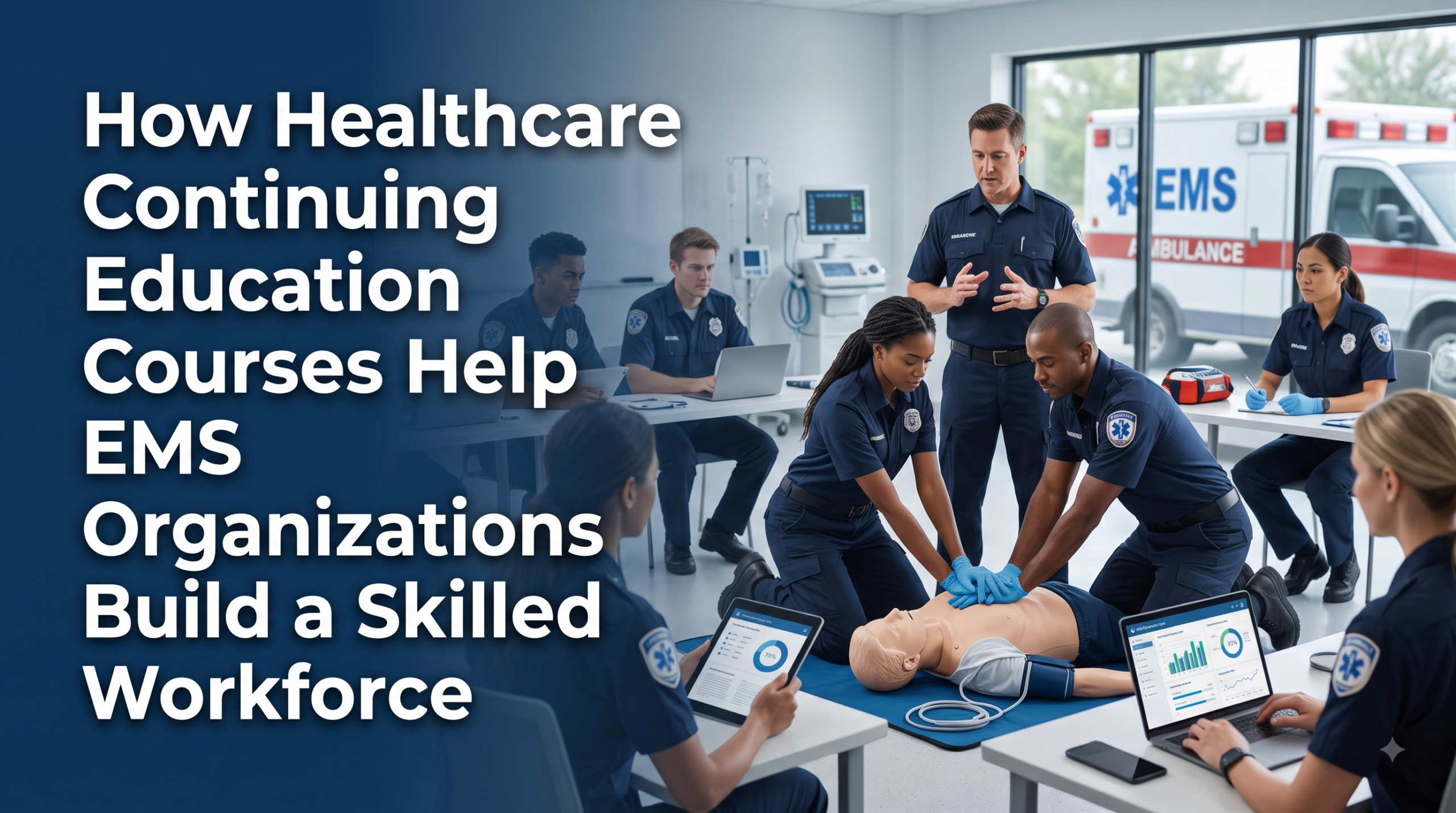
What’s the fastest way to break into emergency medicine without committing to years of school first? For a lot of people in South Florida, the answer is becoming an Emergency Medical Responder. It’s the entry point into EMS, built for people who want real, usable skills fast, whether that’s the start of a full EMS career or just something you want in your back pocket for everyday life. At Emergency Training Academy, our EMR program is designed to get you there without wasting your time.
So, What Exactly Is an EMR?
An Emergency Medical Responder is trained to provide immediate, basic care to someone experiencing a medical emergency or trauma, typically as the very first trained person on scene before an ambulance arrives. Think firefighters, security personnel, lifeguards, industrial safety officers, or folks who simply want a credential that proves they can handle a crisis competently.
It’s not the same as being a paramedic, and it’s not meant to be. EMR is about stabilizing and supporting a patient in those critical first minutes, minutes that genuinely determine outcomes in situations like cardiac arrest or severe bleeding.
The EMS Career Ladder: Where EMR Fits
One thing we hear a lot from prospective students: “I don’t know which level I actually need.” Fair question. Here’s how the levels stack up:
| Level | Approx. Training Hours | Best For |
| EMR | 40 Hours | First responders, workplace safety roles, career starters |
| EMT | 300 hours | Ambulance crews, fire departments, hospital Patient care technician, and patient transport |
| Paramedic | 1,100 hours | Advanced pre-hospital care, ALS-level interventions |
We offer exit points at the EMR, EMT, and Paramedic levels, which means you’re not locked into finishing the entire ladder before you can start working or applying what you’ve learned. Plenty of students start at EMR, get their footing, and then decide whether to keep climbing toward EMT or paramedic later.
What You’ll Actually Learn
We train using three learning domains: cognitive (the knowledge base), affective (decision-making and composure under pressure), and psychomotor (the physical, hands-on skills). It’s the same instructional approach we carry through our entire EMS program, from EMR all the way up through paramedic training, because splitting training into “know it, handle it, do it” genuinely produces more capable responders.
Core skills covered include:
- Scene assessment and patient triage
- Basic airway and respiratory support
- CPR and bleeding control
- Wound care
- Spinal stabilization and splinting
- Assisting with childbirth
- Communicating through Florida’s statewide EMS communications system
You won’t be trained in advanced procedures like intubation or IV therapy at this level (that’s paramedic-level scope), but you’ll walk away with genuinely useful, immediately applicable skills.
A Realistic Look: What Does an EMR Actually Do on the Job?
Let’s be honest about this instead of romanticizing it. An EMR isn’t running codes in an ER or managing a multi-casualty trauma scene solo. What an EMR does is buy time and stabilize a situation before more advanced help takes over: applying pressure to a wound, positioning an airway, starting compressions, calming a scared patient down enough to keep them breathing steady. It’s foundational work, and it matters more than people expect until they’re the one doing it.
Why Train at Emergency Training Academy?
We’ve built our reputation on more than four decades of combined faculty experience across medical, fire, and educational fields. That’s not a marketing line; it shapes how our instructors teach, because they’ve actually worked these scenarios, not just studied them.
A quick snapshot of what backs our program:
- Licensed by the Commission for Independent Education, Florida DOE (License #4770)
- Licensed by the Florida Bureau of EMS (License #154)
- AHA training site and NAEMT training center
- Affiliated with NREMT, FAEMSE, ECSI, AAOS (Control the Bleed), and EVOC
- Field and clinical partnerships with organizations including Miami-Dade Fire Rescue, Coral Gables Fire Rescue, National Health Transport, and American Medical Response
Students who progress beyond EMR into our EMT training program also gain access to hospital rotation partnerships with Northshore Community Hospital, Baptist Health Systems, Hialeah Hospital and Palmetto General Hospital, Fox Medical Center, and Campbell Urgent Care Center as they advance.
Scheduling That Actually Works for Real Life
We know most people considering EMR training aren’t doing it as their only responsibility. You’ve got a job, maybe a family, maybe both. That’s why we offer class-based, hybrid, and online formats with flexible scheduling built around real life, not the other way around.
Is EMR the Right Starting Point for You?
Ask yourself these questions:
- Do you want emergency response skills without committing to a lengthy program right away?
- Are you exploring EMS as a career but not ready to jump straight into EMT or paramedic training?
- Does your current or future job (security, lifeguarding, industrial safety) call for a basic medical response credential?
If you answered yes to any of these, EMR training is a strong starting point. And if down the road you decide you want to go further, whether that’s a first responder course in Miami at the EMT level, or eventually an ACLS course in Miami as part of continuing education, that path is already open to you here.
What Happens After EMR Certification?
Some students stop at EMR because it fully covers what they need for their role. Others use it as the springboard into EMT programs in Florida and beyond, then continue toward paramedic-level training. Either way works, and we don’t push students toward a longer program than they actually need. What we do push for is making sure whichever level you choose, you’re genuinely competent in it, not just certified on paper.
Take the First Step
If you’re ready to start, or just want to talk through which level makes sense for your goals, call us at 305-233-3911. We’ll walk you through scheduling, format options, and what to expect in your first few weeks of training. And if you already know EMR is just the beginning for you, we’re happy to talk through what the EMT and paramedic pathways look like too, so you’re planning your whole route from day one instead of figuring it out as you go. To enroll in the program, please Emergency Training Academy.
Frequently Asked Questions
How long does EMR certification take to complete?
EMR course is 40 hours, it’s our entry-level program and takes considerably less time than EMT or paramedic training, though the exact schedule depends on whether you choose class-based, hybrid, or online formats. We’ll give you a specific timeline based on the format you pick.
Can I become an EMT or paramedic later if I start with EMR?
Yes. EMR is designed as an entry point, not a dead end. Many students use it as a foundation before continuing into our EMT program and eventually paramedic training if they decide to pursue a full EMS career.
Do employers actually recognize EMR certification?
Yes, EMR is a recognized credential used by employers in fields like security, lifeguarding, industrial safety, and some fire service roles that require basic emergency response capability without full EMT licensure.
Is EMR training physically demanding?
It involves hands-on practice, including CPR and patient movement techniques, so there’s a physical component. That said, it’s designed to be accessible, and our instructors work with students to build both the physical and decision-making skills needed together.
