

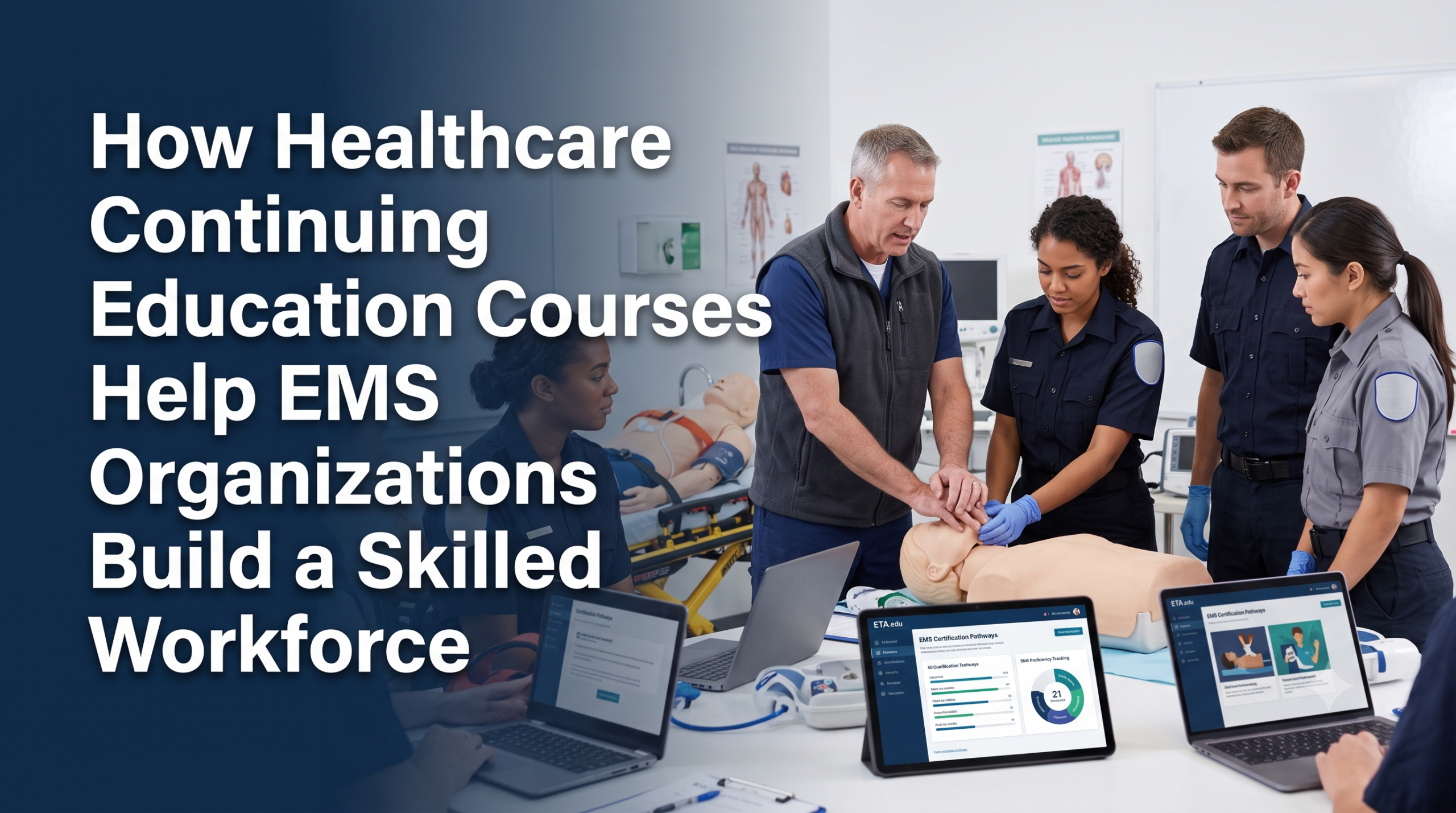
Here’s a question every EMS director eventually has to answer: how do you keep a whole team certified, current, and confident without pulling them off shift for weeks at a time? The answer, more often than not, is the right mix of Healthcare Continuing Education Courses. At Emergency Training Academy, we work with EMS organizations across South Florida to make ongoing training something crews can actually fit into their schedules, not something that disrupts them.
Why Continuing Education Isn’t Optional Anymore
Emergency medicine changes. Protocols get updated, equipment evolves, and the research behind resuscitation and trauma care keeps moving forward. A crew that trained five years ago and hasn’t touched a renewal course since is operating on outdated information, whether they realize it or not.
For EMS organizations, continuing education is less a compliance checkbox and more a workforce strategy. Teams that train together regularly communicate better on scene, catch mistakes faster, and generally handle high-stress calls with more composure. That’s not a soft benefit; it shows up directly in patient outcomes.
What Courses Does ETA Offer?
We built our continuing education catalog around what EMS professionals and healthcare organizations actually need to stay sharp and stay licensed. Courses are available in class-based, hybrid, or fully online formats with flexible scheduling and pricing designed to work for individuals and organizations alike.
| Course | Best For |
| BLS / CPR / AED | Foundational life support skills for all healthcare providers |
| ACLS (classroom or HeartCode hybrid) | Advanced cardiac care for paramedics, nurses, and physicians |
| PALS | Pediatric emergency response |
| PHTLS | Trauma care across the full patient lifespan |
| AMLS | Advanced medical (non-trauma) emergencies |
| EMS Instructor Level A & B | Training the next generation of EMS educators |
| Stop the Bleed | Training lay person the fundamentals of life saving skills of a trauma bleeding patient |
| Active Shooter Response | Preparedness for mass casualty and violent incidents |
If your organization needs to certify or recertify staff across multiple specialties, having one training partner that covers this range saves a lot of scheduling headaches.
PHTLS: A Closer Look at What Makes It Different
Prehospital Trauma Life Support (PHTLS) deserves its own mention because of how widely it’s respected. It was developed jointly by NAEMT and the ACS Committee on Trauma, and it’s recognized globally; the curriculum is currently taught in 47 countries. That’s not a small detail. It means the trauma care principles your team learns in a PHTLS course in Miami are the same ones being taught to providers worldwide.
What makes PHTLS genuinely useful in practice is its approach: it treats every multi-system trauma patient as a unique case rather than applying a one-size-fits-all checklist. The course pushes providers toward critical thinking instead of rote memorization, which matters enormously when real trauma scenes rarely look like the textbook example. Research tied to the program has linked it to improved trauma care quality and decreased mortality, which is really the whole point of continuing education in the first place.
ACLS: What’s Actually Covered
Advanced Cardiovascular Life Support (ACLS) is one of the most requested continuing education courses we run, and for good reason: it’s a core requirement for paramedics, nurses, and many physicians. Our initial course runs 12 to 16 hours, while renewal is 6 to 8 hours.
The course covers:
- Core BLS skills
- Recognition of respiratory and cardiac arrest
- Peri-arrest conditions
- Airway management
- Pharmacology relevant to cardiac emergencies
- Acute coronary syndrome (ACS) and stroke management
- Team dynamics during resuscitation
That last point, team dynamics, is easy to overlook but genuinely important. Cardiac arrest response isn’t a solo performance; it’s a coordinated team effort, and ACLS trains providers to function within that structure, not just execute individual skills in isolation.
Building Instructors, Not Just Certificate Holders
One course that tends to fly under the radar, but shouldn’t, is our EMS Instructor Level A & B program. It’s approved by the Florida Bureau of EMS, acknowledged by FAEMSE, and built to be consistent with the National Guidelines for Educating EMS Instructors. Completing it qualifies you as Adjunct Faculty across didactic, laboratory, and clinical instruction roles.
For EMS organizations thinking long-term, this is worth paying attention to. Training internal staff to become certified instructors means you’re not always dependent on outside providers for onboarding new hires or running refresher sessions. It builds training capacity directly into your organization.
Who Is Continuing Education Really For?
Short answer: pretty much everyone in the emergency medical services or healthcare profession career pipeline. That includes:
- Paramedics maintaining active licensure
- EMTs looking to add specialized certifications
- Nurses and hospital staff who need ACLS or PALS
- Fire departments and private EMS agencies are training entire crews
- Business owners preparing staff for workplace emergencies
If you completed paramedic training in Miami through ETA or elsewhere, continuing education is how you keep that license meaningful. Certifications lapse, protocols change, and skills that go unpracticed do fade; regular training is what keeps your team genuinely field-ready, not just paper-certified.
Why Organizations Choose ETA for Ongoing Training
We’re not a general training company that added EMS courses as a side offering. This is our full focus, backed by over 60 years of combined faculty experience across medical, fire, and educational fields. We’re an AHA training site, an NAEMT training center, and affiliated with NREMT, FAEMSE, AAOS (Control the Bleed), and EVOC. We also hold both a Commission for Independent Education Florida DOE license (License #4770) and a Florida Bureau of EMS license (License #154).
For organizations, that combination of credentials means you’re not just checking a box; you’re partnering with a program that’s held to the same standards your team is held to on scene.
We also try to keep pricing realistic. Continuing education shouldn’t be a budget line item that makes departments choose between training and staffing, so we’ve structured our course pricing to stay affordable for both individuals covering their own recertification and organizations training entire crews at once. Pair that with flexible scheduling, and you end up with a program that fits real-world constraints instead of fighting against them.
Let’s Build Your Team’s Training Plan
Whether you’re managing recertifications for a full EMS crew or looking for a single emergency medical technician course for a new hire, we can help you map out a schedule that actually works. Give us a call at 305-233-3911 or browse our website to learn more, and let’s talk about what your organization needs.
Here’s a question every EMS director eventually has to answer: how do you keep a whole team certified, current, and confident without pulling them off shift for weeks at a time? The answer, more often than not, is the right mix of Healthcare Continuing Education Courses. At Emergency Training Academy, we work with EMS organizations across South Florida to make ongoing training something crews can actually fit into their schedules, not something that disrupts them.
Why Continuing Education Isn’t Optional Anymore
Emergency medicine changes. Protocols get updated, equipment evolves, and the research behind resuscitation and trauma care keeps moving forward. A crew that trained five years ago and hasn’t touched a renewal course since is operating on outdated information, whether they realize it or not.
For EMS organizations, continuing education is less a compliance checkbox and more a workforce strategy. Teams that train together regularly communicate better on scene, catch mistakes faster, and generally handle high-stress calls with more composure. That’s not a soft benefit; it shows up directly in patient outcomes.
What Courses Does ETA Offer?
We built our continuing education catalog around what EMS professionals and healthcare organizations actually need to stay sharp and stay licensed. Courses are available in class-based, hybrid, or fully online formats with flexible scheduling and pricing designed to work for individuals and organizations alike.
| Course | Best For |
| BLS / CPR / AED | Foundational life support skills for all healthcare providers |
| ACLS (classroom or HeartCode hybrid) | Advanced cardiac care for paramedics, nurses, and physicians |
| PALS | Pediatric emergency response |
| PHTLS | Trauma care across the full patient lifespan |
| AMLS | Advanced medical (non-trauma) emergencies |
| EMS Instructor Level A & B | Training the next generation of EMS educators |
| Stop the Bleed | Training lay person the fundamentals of life saving skills of a trauma bleeding patient |
| Active Shooter Response | Preparedness for mass casualty and violent incidents |
If your organization needs to certify or recertify staff across multiple specialties, having one training partner that covers this range saves a lot of scheduling headaches.
PHTLS: A Closer Look at What Makes It Different
Prehospital Trauma Life Support (PHTLS) deserves its own mention because of how widely it’s respected. It was developed jointly by NAEMT and the ACS Committee on Trauma, and it’s recognized globally; the curriculum is currently taught in 47 countries. That’s not a small detail. It means the trauma care principles your team learns in a PHTLS course in Miami are the same ones being taught to providers worldwide.
What makes PHTLS genuinely useful in practice is its approach: it treats every multi-system trauma patient as a unique case rather than applying a one-size-fits-all checklist. The course pushes providers toward critical thinking instead of rote memorization, which matters enormously when real trauma scenes rarely look like the textbook example. Research tied to the program has linked it to improved trauma care quality and decreased mortality, which is really the whole point of continuing education in the first place.
ACLS: What’s Actually Covered
Advanced Cardiovascular Life Support (ACLS) is one of the most requested continuing education courses we run, and for good reason: it’s a core requirement for paramedics, nurses, and many physicians. Our initial course runs 12 to 16 hours, while renewal is 6 to 8 hours.
The course covers:
- Core BLS skills
- Recognition of respiratory and cardiac arrest
- Peri-arrest conditions
- Airway management
- Pharmacology relevant to cardiac emergencies
- Acute coronary syndrome (ACS) and stroke management
- Team dynamics during resuscitation
That last point, team dynamics, is easy to overlook but genuinely important. Cardiac arrest response isn’t a solo performance; it’s a coordinated team effort, and ACLS trains providers to function within that structure, not just execute individual skills in isolation.
Building Instructors, Not Just Certificate Holders
One course that tends to fly under the radar, but shouldn’t, is our EMS Instructor Level A & B program. It’s approved by the Florida Bureau of EMS, acknowledged by FAEMSE, and built to be consistent with the National Guidelines for Educating EMS Instructors. Completing it qualifies you as Adjunct Faculty across didactic, laboratory, and clinical instruction roles.
For EMS organizations thinking long-term, this is worth paying attention to. Training internal staff to become certified instructors means you’re not always dependent on outside providers for onboarding new hires or running refresher sessions. It builds training capacity directly into your organization.
Who Is Continuing Education Really For?
Short answer: pretty much everyone in the emergency medical services or healthcare profession career pipeline. That includes:
- Paramedics maintaining active licensure
- EMTs looking to add specialized certifications
- Nurses and hospital staff who need ACLS or PALS
- Fire departments and private EMS agencies are training entire crews
- Business owners preparing staff for workplace emergencies
If you completed paramedic training in Miami through ETA or elsewhere, continuing education is how you keep that license meaningful. Certifications lapse, protocols change, and skills that go unpracticed do fade; regular training is what keeps your team genuinely field-ready, not just paper-certified.
Why Organizations Choose ETA for Ongoing Training
We’re not a general training company that added EMS courses as a side offering. This is our full focus, backed by over 60 years of combined faculty experience across medical, fire, and educational fields. We’re an AHA training site, an NAEMT training center, and affiliated with NREMT, FAEMSE, AAOS (Control the Bleed), and EVOC. We also hold both a Commission for Independent Education Florida DOE license (License #4770) and a Florida Bureau of EMS license (License #154).
For organizations, that combination of credentials means you’re not just checking a box; you’re partnering with a program that’s held to the same standards your team is held to on scene.
We also try to keep pricing realistic. Continuing education shouldn’t be a budget line item that makes departments choose between training and staffing, so we’ve structured our course pricing to stay affordable for both individuals covering their own recertification and organizations training entire crews at once. Pair that with flexible scheduling, and you end up with a program that fits real-world constraints instead of fighting against them.
Let’s Build Your Team’s Training Plan
Whether you’re managing recertifications for a full EMS crew or looking for a single emergency medical technician course for a new hire, we can help you map out a schedule that actually works. Give us a call at 305-233-3911 or browse our website to learn more, and let’s talk about what your organization needs.
Frequently Asked Questions
How often do EMS professionals need to renew certifications like ACLS or BLS?
Renewal timelines vary by certification date of completion and employer requirements, but most run on a two-year cycle. We recommend checking with your organization’s specific policy, then scheduling your renewal course well before expiration to avoid a lapse.
Can our organization schedule group training instead of individual enrollment?
Yes. We regularly work with fire departments, private EMS agencies, and healthcare organizations to schedule group sessions, which helps keep entire teams certified on a consistent timeline.
Is online training as effective as in-person for hands-on skills like CPR?
For skills-based certifications, we use hybrid formats like HeartCode ACLS, where online coursework covers the knowledge portion and an in-person session covers hands-on skills testing. This keeps the practical, physical component intact while adding flexibility.
Do I need to already work in EMS to take these courses?
No. Many of our continuing education courses, including BLS and ACLS, are open to nurses, physicians, dental staff, and other healthcare professionals who need these certifications for their roles, not just EMS providers.
