

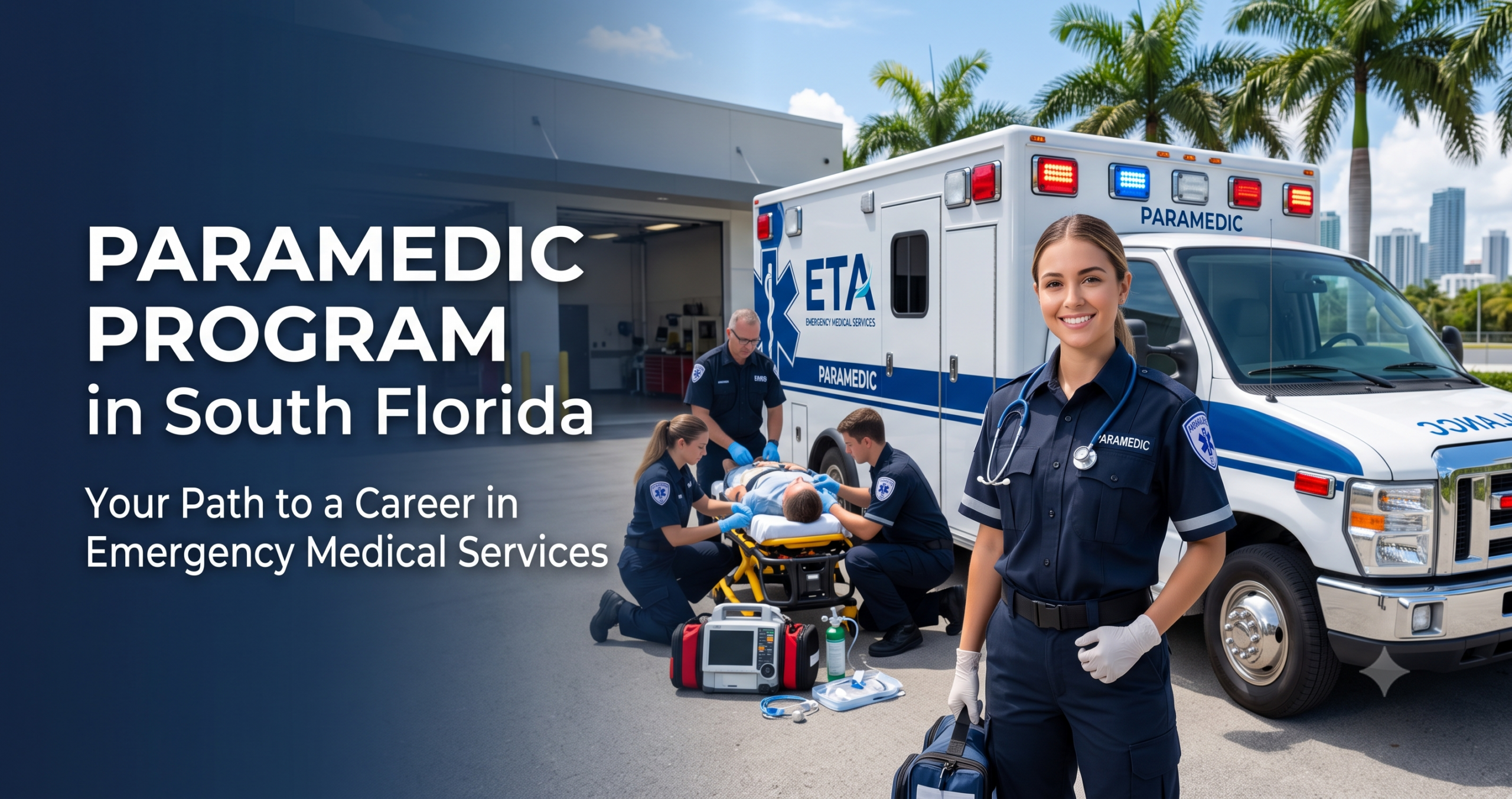
Thinking about a career where no two days look the same, and where your skills genuinely save lives? A Paramedic Program in South Florida might be exactly what you’re looking for. At Emergency Training Academy, we train future paramedics for the reality of the job, not just the textbook version of it. If you’re weighing your options for an emergency medical services career in Miami, here’s what you actually need to know before you enroll.
What Is a Paramedic Program?
A paramedic program is the highest level of pre-hospital EMS training you can get in Florida. It builds on your EMT license and prepares you to handle advanced, often life-or-death interventions in the field: things like cardiac emergencies, respiratory failure, and severe trauma. Paramedics don’t just stabilize patients; they make critical clinical decisions under pressure.
At ETA, our paramedic program is 1,100 hours and follows the US DOT curriculum, National EMS Education Standards, and Florida Bureau of EMS standards. That means when you graduate, you’re not just meeting a minimum bar; you’re trained to a standard recognized across the country.
Why Choose ETA for Your Paramedic Training?
We’ve been doing this for a while, and it shows. Our faculty brings over 60 years of combined experience across medical, fire, and educational fields, so you’re learning from people who’ve actually worked the calls, not just talk about them.
A few things that set our program apart:
- Real hospital and EMS affiliations. Students train through partnerships with Baptist Health Systems, Northshore Hospital, Hialeah Hospital, Palmetto General, Hospital, Fox Medical Center, and Campbell Urgent Care Center, along with field placements through Miami-Dade Fire Rescue, Coral Gables Fire Rescue, Hialeah Fire Rescue, E-Care Ambulance, National Health Transport, and American Medical Response.
- Flexible scheduling. Class-based or hybrid options exist so working students, parents, and career-changers can actually fit training into their lives.
- Licensed and accredited. ETA holds a Commission for Independent Education Florida DOE license (License #4770) and a Florida Bureau of EMS license (License #154). We’re also an AHA training site, an NAEMT training center, and affiliated with NREMT, FAEMSE, AAOS (Control the Bleed), and EVOC.
If you’re comparing programs, this combination of hands-on clinical access and flexible formats is worth putting at the top of your checklist.
How the Program Is Structured
Our teaching approach isn’t accidental. We build every phase around three learning domains: cognitive (what you know), affective (how you think and behave under pressure), and psychomotor (what you can physically do). It’s a method designed to produce paramedics who don’t freeze up when it matters most.
The program moves through four connected phases:
| Phase | What Happens |
| Didactic | Classroom instruction covering EMS theory, pharmacology, anatomy, and protocols |
| Hands-On Training | Skills labs where you practice procedures in a controlled, supervised setting |
| Hospital Rotations | Real clinical exposure at our affiliated hospital partners |
| Field Internship | Supervised patient care while working alongside EMS crews |
Each phase builds on the last, so by the time you’re in the field, you’ve already handled similar scenarios in a supported environment.
What Skills Will You Actually Learn?
This is usually the part prospective students care about most, and fair enough. Here’s a snapshot of the core skills covered in our paramedic training:
- Scene assessment and patient triage
- Advanced airway management and respiratory intervention
- CPR, bleeding control, and wound care
- Spinal stabilization and splinting
- Childbirth assistance
- Medication administration
- Drug Calculations
- EKG Interpretation
- Intravenous insertion skills
- Communication through Florida’s statewide EMS communications system
Beyond the fundamentals, you’ll also train in advanced procedures that separate paramedics from other EMS levels: surgical cricothyrotomy, IV therapy, cardioversion, defibrillation, and endotracheal intubation. These are the interventions that can mean the difference between a patient surviving transport or not, and we don’t treat them as an afterthought in our curriculum.
Do You Need to Be an EMT First?
Yes, and here’s why that matters. EMT certification is a prerequisite for our paramedic program, and for good reason: it gives you the foundational patient care experience that paramedic-level training builds on. Our EMT training program is 300 hours and gets you ready for exactly this next step.
If you’re not sure which entry point makes sense for you, we also offer exit points at the EMR and EMT levels, so you can start where it fits your goals and timeline, then move forward when you’re ready.
Is a Paramedic Career Actually Worth It?
We get asked this a lot, and honestly, it depends on what you’re after. If you want a career that’s routine and predictable, this probably isn’t it. But if you want work that matters, where you’re the difference-maker on someone’s worst day, an emergency medical services career in Miami offers that in a way few other fields can.
Miami’s dense population, tourism traffic, and hurricane exposure mean local EMS demand isn’t slowing down anytime soon. Paramedics here work across fire departments, private ambulance services, hospitals, Air Medical Transport and event medical teams; the career paths branch out more than people expect when they start.
Beyond the Paramedic License: Staying Sharp
Getting licensed is the start, not the finish line. Once you’re working, ongoing certification keeps your skills current and your resume competitive. We offer an ACLS course in Miami along with AHA BLS certification in Miami as part of our continuing education lineup, so you can renew and expand your credentials without having to search around for another provider you don’t already trust. Our continuing education courses also include PALS, PHTLS, and AMLS for paramedics who want to specialize further down the line.
Ready to Start Your Paramedic Journey?
Choosing a paramedic program is a real decision, not something to rush. But if you want a program built on real clinical partnerships, experienced faculty, and a curriculum that actually prepares you for the field, we’d love to talk with you about it. Call us at 305-233-3911 or reach out to learn more about enrollment, scheduling, and what your first semester could look like.
